

Alvaro Campo - Time Observatory
The measure of change. About clock time, solar time and change.
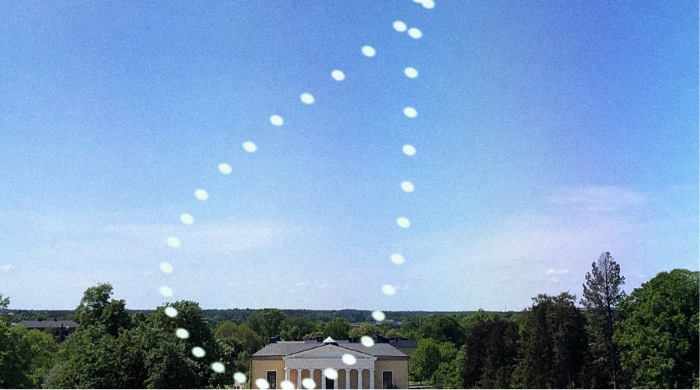
After a spring of social distancing, the question of what time actually is is unusually relevant. For some, time has stopped in structurelessness and monotony, while others are waging an intense fight against the spread of infection and its effects. Clock time, which became dominant with the industrial revolution, which often increases the work pulse, but also provides stability, is not present in the same way. Instead, the cracking of spring leaves, the chirping of birds and the changes in the weather have been more clearly registered by many. At the same time, this heightened sense of life brings with it the knowledge that life for many others is very fragile right now.
For the artist Alvaro Campo, his areas of interest and working methods have not changed. His work is based on everyday perception and a recording of the changes in light, shadows, seasons and weather phenomena. Trained in photography at ICP in New York, he is one of the artists who have brought with them the photographic working methods and questions, but have largely left the two-dimensional surface.
The exhibition The Measure of Change spans different media such as installations and drawing. In Gravity, a conceptual performance, the visitor is invited to examine his own gravity. Another formalistic element is the square, which recurs as a surface for reflections, for example in the form of a projection screen in the forest. Untitled (Direct cinema / Cinema Vérité), “illuminates” and frames something as simple as the sun glinting between trees in the forest.
The exhibition has emerged from conversations with researchers in astronomy, philosophy, biology and climate change, about what time is and how we can understand ourselves based on the processes of nature. The title The Measure of Change comes from the philosopher Aristotle's thoughts that time is change. Aristotle, who was interested in natural processes, understood time as a measure of movement, for example the movement of the sun in the sky. In the same way, we are invited here to register and relate our bodies to a larger cosmic context. How the sun and the moon control our cyclical time and how gravity pulls us towards the ground.
Theoretical physicist Carlo Rovelli has highlighted the paradox that despite the fact that time so largely governs our lives, we cannot say with certainty what time actually is. What happens if we allow ourselves to stop and perhaps reconsider some of the principles that seem so central to today's society? Douglad Hine expresses in the conversation "Coming to Our (Animal) Senses" with David Abram that our mute way of being in the world has "enslaved the present into the future", an expression of the myth of the idea of progress.
In the work Eight automated rainbows and the progress of flowers outdoors in the castle courtyard, Alvaro Campo allows the development of plants in pallet collars to be the progress itself. We “marvel” at the beauty of the rainbow, as in the English “wonder”. In many cultures, rainbows are a symbol of the divine, and can be seen as a tribute to diversity. The 17th-century philosopher Renée Descartes, who stayed in the castle for periods during the time of Queen Christina, already demonstrated the optical and meteorological function when light waves are refracted in water droplets and a prism is created. Descartes lived during the “Telescopic Age” and optics represented the latest scientific breakthrough. Like many early scientists, Descartes had a broad range of interests in philosophy, mathematics and cosmology and also worked as a lens grinder.
In many ways, Alvaro Campos’s broad explorations resemble these scientific predecessors. Mathematical calculations, astronomy and optical observations result in artworks that are open to the viewer. They capture the fleetingness of the present and raise questions about our place in relation to the movements of celestial bodies and all living things.
In collaboration with Gustavianum, Uppsala University Museum, Alvaro Campos’ artistic explorations of the concept of time have led to four interviews that were filmed and edited by the artist and are now on display in the exhibition.